

16th century
The origins
The original building
A fortified house in the county of Montpensier
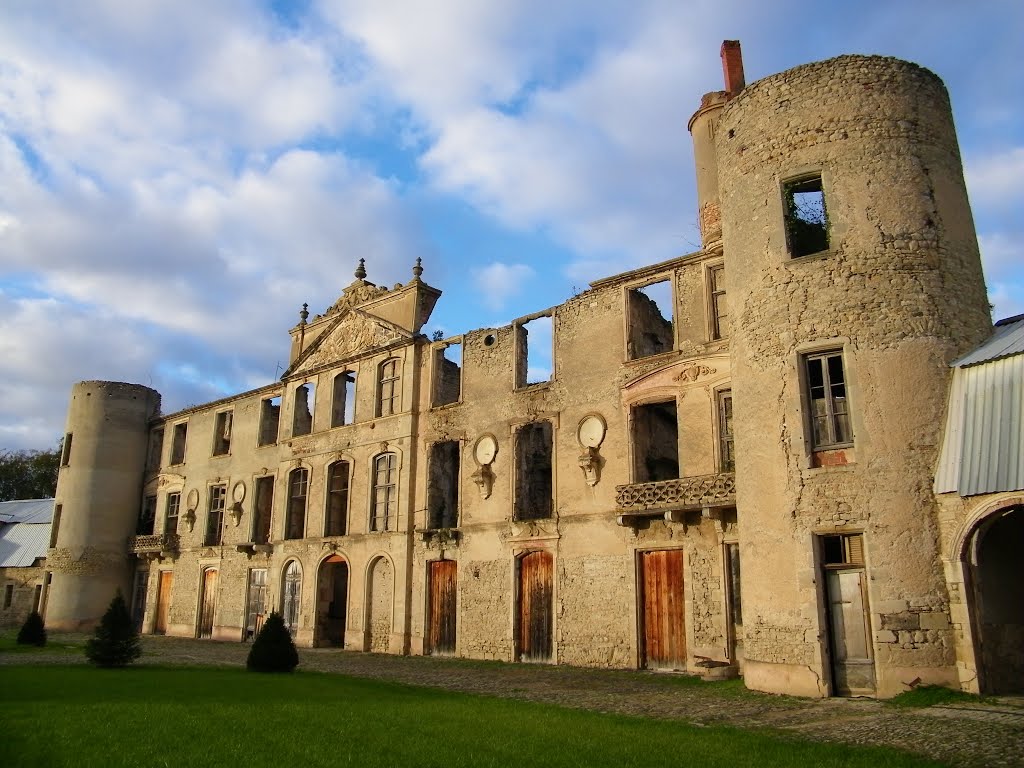
Villemont was originally a modest estate, described in an early 16th-century inventory as a « house, motte, moat and farmyard of Villemont ». It belonged to the county of Montpensier, then held by the Constable of Bourbon before being confiscated by Francis I to make him pay for his treason. Passing to Michel de Veyny, nephew of Chancellor Duprat, the estate remained in the same family — through the female line: Mallet de Vendègre, du Maisniel, de Sampigny, de Durat — until its sale in 1958, shortly before the fire that destroyed it.
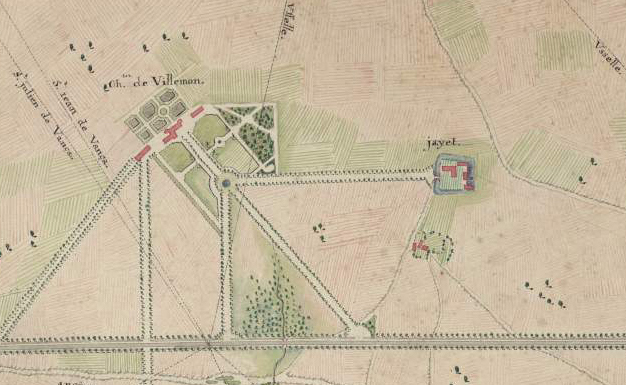
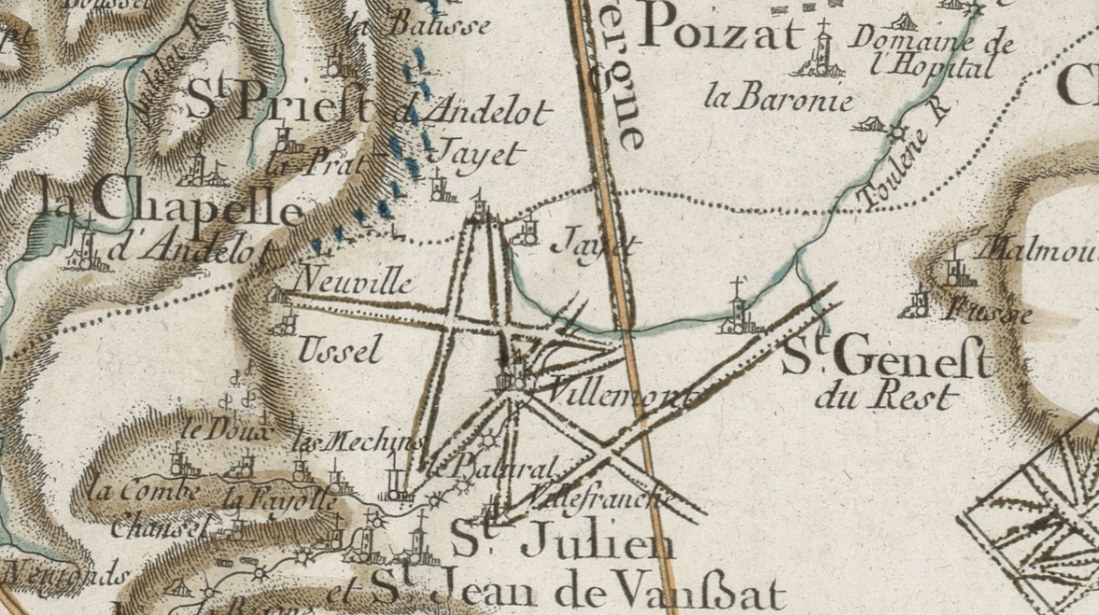
The first major building was the work of Michel de Veyny, in the middle of the 16th century. The ensemble then consisted of a main L-shaped dwelling framed by two wings. The south-facing façade was flanked by two towers with conical roofs; formal gardens stretched to the south, while bridle paths radiated in a star to the north. It was a richly furnished house — tapestries, four-poster beds, silverware, gilded leather — which in 1566 received King Charles IX, his mother Catherine de’ Medici and Chancellor Michel de l’Hospital.
Sources and further reading
- Sabine Codet, « Le château de Villemont », Bulletin monumental, vol. 127, no. 2, 1969, p. 157 (read on Persée).
- Trudaine atlas, road maps of the kingdom surveyed for the Ponts et Chaussées (1745-1780), Archives nationales.
- General map of the kingdom known as the Cassini map, 1:86,400, second half of the 18th century.
- French Ministry of Culture, Mérimée database, record PA00092456 « Château de Villemont » (view).